
The Sincerity Trap: Why the Best People in AI Aren’t Telling You What They Actually Think
20 mins | Dean Ball, Dario Amodei, Eric Schmidt, and the Structural Gap Between What AI Insiders Believe and What Reaches the Rest of Us


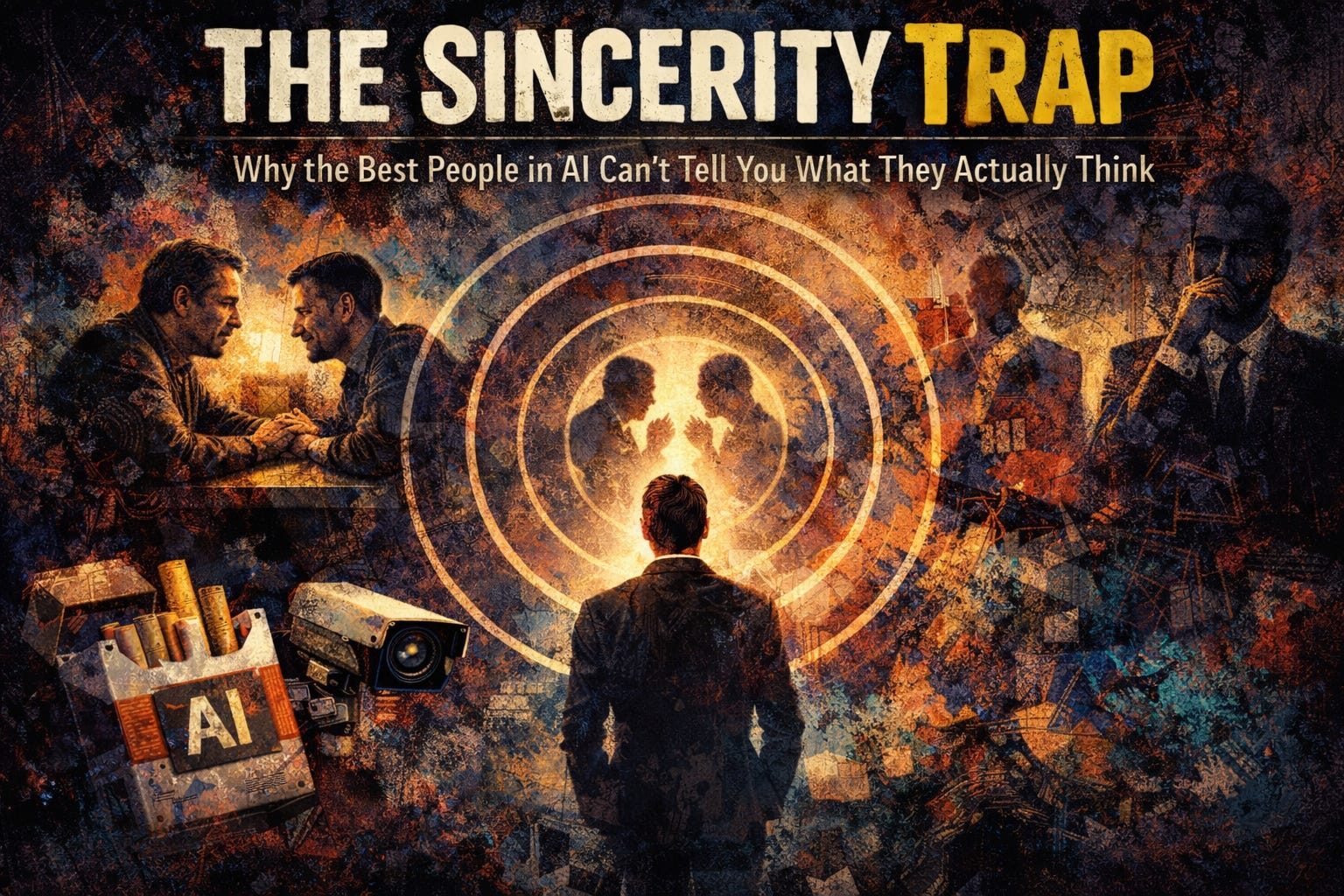
A billionaire sits at his kitchen table in East London with Steven Bartlett. Bartlett hosts Diary of a CEO, one of the most listened-to podcasts in the world. The billionaire knows the CEO of one of the biggest AI companies on earth. And what he tells Bartlett is simple:
“What he tells me in private is not what he’s saying publicly.”
What this CEO thinks is going to happen with AI, Bartlett later recounted, is “pretty horrific.” The CEO is “totally cool with it.” And when Bartlett watched the same person give his polished public talks— measured, optimistic, assuring everyone things would be fine— the gap hit him. Then Bartlett remembered the kitchen table. “It was chilling.”
Bartlett reached for an old comparison. “You won’t have anybody who owns an AI company talking doomsday scenarios. It’s not in their economic interest, even if they secretly harbor that. It’s like people who used to run cigarette companies didn’t smoke and didn’t let their family smoke.”
Then he offered one more detail. He recalled visiting Facebook in its earlier days and walking into the cafeteria. The employees ate at communal picnic benches. They told him with pride that these shared eating areas helped people maintain relationships. Bartlett found this hilarious. “You literally have a product that breaks relationships, and yet you understand enough to make people eat together at lunchtime so that they’ll maintain relationship.”
The people who built the machine that fragments human connection understood this well enough to design their own workplace to counteract it. They were not ignorant. They knew. They just organized that knowledge into different compartments. One for the product shipped to two billion users. One for the cafeteria where they ate lunch.
This essay is about that gap. The space between what the people shaping AI actually believe and what they tell the rest of us. I call the mechanism that makes this gap invisible the Sincerity Trap, and I will show how it operates.
This is not about villains. The people profiled here are, by most accounts, genuinely trying to do the right thing. Some have sacrificed significant career capital to hold ethical positions. At least one walked away from a $200 million government contract rather than compromise on principles.
But Bartlett’s account also described something darker in the unnamed CEO: “the obsession with power was shocking to me.” So the range runs wide. Some insiders filter their communication out of institutional pressure. Some may filter it for reasons less sympathetic.
That distinction matters, but it is not the most important finding. The most important finding is that even in a world populated entirely by the thoughtful and the earnest, the pattern I am about to describe would still operate. A villain story has a solution: remove the villain. This story does not have that resolution. There is no one to remove. There is only the structure, and all of us inside it.
Concentric Circles
Every human operates within concentric circles of disclosure.
The innermost circle is the 3:27 am thought. The thing you think when the house is dark, the one you would not say to anyone. Maybe you can barely say it to yourself. It sits inside like a weight you’ve learned to carry, surfacing when the tides are low and the water is still.
One ring out: the person you share a bed with. The things you say in the half-dark, when the performance of the day has dropped away. More honest than anything you would say publicly. Still shaped by the relationship. You don’t say everything. You say what the relationship can hold.
Then the close friends, the group chats, the handful of people you trust enough to think out loud around. Then the professional in-group: closed-door industry events, private Slack channels, advisory calls, Stanford lectures you believe are off the record. Then the semi-public layer— podcasts, Substacks, op-eds— where the Overton window determines what is safe to say. Then the fully public layer: formal policy documents, government testimony, press releases. And downstream of all of it, the news articles and social media clips through which most people actually encounter the signal.
At each transition, information changes. Not randomly. Systematically. Shaped by the incentive structure at each layer.
And the circles are fractal. Inside any single organization, the same pattern reproduces. What the CEO tells the board is not what the C-suite hears. The senior engineer gets a different version. The new hire gets another. The company blog gets a fifth. Even within a single circle, there are subcircles of trust. The filtering happens at every scale of human social organization simultaneously.
By the time a signal reaches you, it has been adjusted at potentially dozens of transition points. Nobody at any individual point needs to be lying for the composite signal to be fundamentally misleading. Each person at each layer makes locally rational decisions about what to share. The aggregate effect is systematic distortion without a deliberate deceiver.
The social scientist Timur Kuran named a version of this: preference falsification, the act of publicly expressing beliefs different from what you privately hold because of social pressure. In Private Truths, Public Lies (1995), Kuran showed how this creates reputational cascades where everyone misrepresents their views because they believe everyone else holds the publicly stated position. Discourse drifts away from what participants actually think. No conspiracy, just incentive structures.
But Kuran described falsification within a single social layer. What I am describing is cascading falsification across nested layers, where each layer’s output becomes the next layer’s input. The distortion compounds.
The Genealogy
Bartlett’s cigarette comparison is more than an analogy. It is a genealogy. The same pattern, carried forward by many of the same people, across three waves of innovation.
The cigarette executives are old news, settled history. But the social media era is not old. It is still ongoing.
In 2017, Chamath Palihapitiya stood before students at the Stanford Graduate School of Business. He had been Facebook’s vice president for user growth. He told them he felt “tremendous guilt” for what he’d helped build. “The short-term, dopamine-driven feedback loops that we have created are destroying how society works.” His children, he said, “are not allowed to use this shit.”
Then he added something that should sound familiar: “I think we all knew in the back of our minds, even though we feigned this whole line of ‘unintended consequences.’ I think in the back, deep, deep recesses of our minds, we kind of knew something bad could happen.”
He knew. While building it, he knew.
And he said nothing publicly until years later, when he was no longer at the company and the cost of honesty had dropped to near zero. His admission changed nothing structural. The products continued. The business models persisted. No regulatory framework emerged to prevent the same dynamics from repeating.
This is why calling it a genealogy matters. The people who built social media, who admitted they knew what it was doing, who expressed their guilt at Stanford lectures after the fact— many of these same people are now the investors, advisors, and board members of the companies building artificial intelligence. The accountability gap that was never closed in social media did not disappear. It was inherited by the next generation of technologists. The same culture. The same incentive structures. The same concentric circles. Now applied to a technology whose own architects describe it as potentially the most powerful and dangerous in human history.
Three People Caught Between Circles
What lifts this beyond theory is that we have documented cases— not inferred but explicitly narrated by the people themselves— of the filtering operating in real time. In each case, we can see the gap between inner-circle communication and outer-circle presentation. In each case, the person caught in the gap told us it was there.
Dean Ball
Dean W. Ball is a senior fellow at the Foundation for American Innovation. He previously served as senior policy advisor for AI at the White House Office of Science and Technology Policy. He was the primary author of America’s AI Action Plan— the document that formally articulated the Trump Administration’s approach to artificial intelligence. It shapes how the most powerful government on earth relates to what may be the most consequential technology ever built. That document is his Circle 6 output.
On April 1, 2026, Ball appeared on the Win-Win podcast with Liv Boeree, a show built around Stephanie Lepp’s experimental “anti-debate” format designed to surface synthesis rather than score points. Speaking to a knowledgeable audience, he said:
“This is the year of me saying things out loud that I believed for several years but didn’t say out loud for Straussian reasons, but now is important to say out loud.”
The word Straussian does enormous work. It refers to the political philosopher Leo Strauss, whose interpreters argue that serious thinkers sometimes conceal their true views from the public. To invoke Strauss is not to describe honest uncertainty that later resolved. It is to describe deliberate concealment.
What followed was a cascade of disclosures. Ball said he believes the US government, once it grasps what AI represents, “is going to try to take over the world.” He described Silicon Valley elites as “much lower quality than I realized. They understand how the world works way, way less well than I realized.” He admitted the AI Action Plan contained errors: “I’ve concluded that I was thinking about that problem somewhat wrong when I wrote the action plan.”
And then he said this: “I model our political system as kind of a dying person in hospice and our job is to make them feel cozy as this happens. We are the young people and we have to make them feel okay about their death.”
The senior AI policy advisor to the White House privately modeled the political system he served as a terminal patient. His role, as he understood it, was not to cure but to comfort. He was writing the prescription knowing the patient was dying. He was managing comfort, not preventing death.
He said all of this publicly. But only after leaving government. Only after the Overton window had shifted. Only after it was safe.
And here is what makes this stranger still. When Ball finally removed the Straussian filter, the things he said bore striking resemblance to ideas that had been circulating for years— in communities he would not normally be associated with. Ball, a conservative policy advisor, described the political system as “a dying person in hospice.” In 2021, Vanessa Machado de Oliveira (also known as Vanessa Andreotti)— a scholar rooted in indigenous and decolonial thought, writing from an entirely different intellectual tradition— published Hospicing Modernity, a book arguing that modernity itself is dying and requires compassionate accompaniment rather than futile rescue. Different traditions. Nearly identical structural metaphor. In the same episode, Ball described the path forward as a narrow tightrope. Connor Leahy’s ControlAI published A Narrow Path— an extensive treatment of the same structural dilemma. These thinkers do not cite each other. Some have been labeled “doomers,” a term Ball’s own professional circles used dismissively. And yet, once Ball’s filter dropped, he arrived at the same diagnosis.
Listen to the full podcast and you hear someone genuinely wrestling with impossible tradeoffs. He spent a year walking around the Stanford campus having what he called “soulful conversations with myself.” He openly acknowledges the weakness of his own position: “We do have to kind of get lucky.” Ball is not a cynical operator. He is someone who took a role where his honest beliefs were incompatible with the job’s requirements, and he chose the role.
That is what makes this important. If the person writing America’s AI policy was this thoughtful, this morally serious, and this filtered, then the filtering is not about character. It is about structure.
Dario Amodei
Dario Amodei is the CEO of Anthropic. His published essays— Machines of Loving Grace and The Adolescence of Technology— articulate a vision of AI that is measured, philosophically informed, and cautiously hopeful. These are his Circle 5-6 documents: carefully composed, widely read, designed to communicate Anthropic’s worldview to the public.
In early 2026, Anthropic’s $200 million contract with the Pentagon collapsed. The company had two restrictions: its AI could not be used for fully autonomous weapons or mass domestic surveillance. When the Pentagon demanded those restrictions be removed, Anthropic refused.
Then the circles collapsed.
At Circle 5-6, Amodei’s public statements were principled and measured. It was not the role of any private company to be involved in operational military decision-making. The restrictions were narrow. The company supported national security within appropriate bounds. At Circle 3, an internal memo to staff— leaked to The Information— showed a different register entirely. Amodei called OpenAI’s competing Pentagon deal “safety theater.” He described Sam Altman’s statements as “straight up lies.” He called OpenAI employees “a gullible bunch.” He accused the Trump administration of targeting Anthropic because it hadn’t offered “dictator-style praise.”
When the memo became public, Amodei apologized. His words: “It was a difficult day for the company, and I apologize for the tone of the post. It does not reflect my careful or considered views.”
He is saying, in plain language, that what he communicated internally does not represent what he presents externally. He is narrating the existence of the circles.
And the apology was a third voice. Not the public principled stance. Not the private fury. A damage-control register that belongs to no stable circle— one that emerges only when the boundary between circles fails.
Eric Schmidt
Eric Schmidt served as CEO and executive chairman of Google. He chaired the National Security Commission on AI, whose 756-page report shaped American AI policy for years. He has published work on Mutually Assured AI Malfunction (MAIM)— frameworks for managing great-power AI competition. These are Circle 5-6 outputs: formal, institutional, designed to influence policy at the highest levels.
In August 2024, Schmidt gave a lecture at Stanford. He thought it was private. Stanford posted the video on YouTube.
He told students that AI startups should “steal all the users, steal all the music” from competitors, then “hire a whole bunch of lawyers to go clean the mess up” if the product takes off. He criticized Google with a bluntness unthinkable in any public interview. He assessed global AI competition with a frankness that would be incendiary in diplomatic settings.
And then, after advising the audience to steal intellectual property: “Do not quote me.”
He was on camera.
Schmidt was attempting to invoke the circle boundary in real time. This is Circle 4 information. Do not move it outward. The management was so habitual, so deeply embedded in how he navigates the world, that he attempted it when enforcement was already impossible.
There is another pattern in the Stanford transcript. Schmidt repeatedly says “in the spirit of full disclosure” before sharing something candid. This is circle-lowering language— a verbal signal that the speaker is temporarily dropping to a more intimate register. It functions as social currency: the audience gets the feeling of being granted access to a higher circle. It creates intimacy as a gift.
When the video went public, Schmidt contacted Stanford to have it removed. The same words, the same speaker. But the circle had shifted, and everything changed.
What Connects These Three
Across these cases, the evidence is not inferred. These people are narrating their own circle management in documented, verifiable statements:
Ball: “I believed for several years but didn’t say out loud for Straussian reasons.”
Amodei: “It does not reflect my careful or considered views.”
Schmidt: “Do not quote me.” On camera.
We are not reading between lines. We are reading what they told us about the gap between their circles.
And each of them has produced a major public document representing their most filtered thinking. Ball’s AI Action Plan. Amodei’s essays. Schmidt’s NSCAI report. These documents are read by hundreds of thousands, sometimes millions, of people trying to understand what AI means. They are the Circle 6 output. They are the map. And they were drawn by people who, at Circle 2 and 3, saw a different territory.
Those Who Chose Differently
Not everyone stays inside the circles.
Geoffrey Hinton spent a decade at Google as one of the most important figures in AI— a pioneer of deep learning whose work underpins essentially every modern AI system. In May 2023, he resigned. His reason: “I want to talk about AI safety issues without having to worry about how it interacts with Google’s business. As long as I’m paid by Google, I can’t do that.”
That sentence is a precise description of the circle constraint. While inside Google, his assessment of AI risk was filtered through the institution’s business interests. After leaving, the filter lifted. Same person. Same knowledge. Different output. He went on to estimate a 10-20% probability of human extinction from AI, joined the board of the AI Safety Foundation, launched an annual lecture series on AI risk, and became one of the most visible advocates for safety regulation.
Daniel Kokotajlo was a researcher at OpenAI. He became increasingly convinced that the company’s justifications for rapid development were, as he put it, “basically rationalizations.” He described hearing different stories at different moments: “it’s better for us to win because we’re a nonprofit,” “we have to go fast in order to go slow later.” He left. The cost was significant— by multiple reports, forfeited equity. He founded the AI Futures Project and produced AI 2027, a detailed scenario of near-future AI development that has proven remarkably accurate.
Connor Leahy reverse-engineered GPT-2 alone in a dorm room at nineteen, co-founded EleutherAI to build open-source language models, and then did something unusual: he looked at what he’d helped build and concluded it was dangerous. He founded Conjecture, an AI safety company, because the major labs were not going to solve the alignment problem on their own. “If they just get more and more powerful, without getting more controllable,” Leahy has said, “we are super, super fucked.” His affiliated organization, ControlAI, published A Narrow Path, a framework for navigating the thin viable route between catastrophic outcomes.
These exits matter because they demonstrate that the filtering is a choice. An expensive choice. Hinton gave up a prestigious position. Kokotajlo gave up equity. Leahy sacrificed competitive advantage. But it can be done. And what each of them built on the outside— the lectures, the organizations, the reports— are attempts to transmit what the inside had suppressed.
The concentric circles do more than separate insiders from the public. They separate potential intellectual allies from each other. While Ball was filtering for Straussian reasons, the potential convergence between his structural analysis and the work of Andreotti, Leahy, and others was blocked. The circles do not just delay information. They delay synthesis.
The Sincerity Trap
Each person profiled here is, by most accounts, genuinely trying.
Their sincerity is not in question.
And that is precisely the problem.
We evolved to detect intentional deception. Shifty eyes. Inconsistent stories. The micro-expressions that betray conscious untruth. Our social cognition spent millions of years tuning itself to this threat.
We did not evolve to detect structural filtering— a sincere person telling the truth as they experience it at their particular circle, which is genuinely different from the truth at a different circle. There is nothing to detect. No deception is occurring. The speaker believes what they are saying. They are being honest, at that layer, under those conditions, for that audience.
I call this the Sincerity Trap: the phenomenon where genuine earnestness makes the filtering invisible, because we pattern-match sincerity to honesty.
But they are not the same thing.
Amodei is not lying when he publishes a thoughtful essay about AI’s potential. He is being sincere at Circle 5-6. The internal memo is not the “real” Amodei, with the essay being fake. Both are real, produced by the same person under different conditions. But the reader at Circle 6 has no way to know that a substantially different assessment exists at Circle 3: angrier, blunter, more alarmed.
They are telling you what they really think. They are just not telling you all of it.
The Noble Lie
Some will argue the filtering is necessary. That Amodei should say different things publicly and privately, because panic would be counterproductive. That Ball was right to tiptoe while in government. That Schmidt’s candor was appropriately reserved for an audience that could contextualize it.
This is the strongest defense of the concentric circles, and it deserves honest engagement.
But it has a problem that cannot be resolved from the outside. If someone tells you “I am withholding information for your own good,” you have no way to distinguish that from “I am withholding information for my own good and claiming it’s for yours.” The Sincerity Trap applies to the noble lie itself. The person filtering may genuinely believe their concealment serves the public interest. But the same incentive structures that reward filtering also reward believing the filtering is noble. Career preservation, institutional loyalty, financial security— all of these create powerful motivation to conclude that the truth you’re withholding is the truth the public doesn’t need.
This cannot be resolved from the outside.
Every noble lie in recent American history was defended, at the time it was being told, with the same reasoning: the public would panic, the institutions would destabilize, the cure would be worse than the disease. The Pentagon Papers. The pre-2008 assurances about financial stability. The intelligence assessments that preceded the Iraq War. The withheld truth always came out anyway. The only thing the withholding prevented was the chance to prepare.
Epistemic Inequality
The knowledge is real. Anthropic knows what its newest model can do. Amodei knows what he believes about AI’s trajectory. The Treasury Secretary knew enough, in April 2026, to summon the CEOs of Citi, Morgan Stanley, Bank of America, Wells Fargo, and Goldman Sachs to an emergency meeting about cybersecurity risks from a single AI model. Hinton knows what he saw at Google that made him resign.
The problem isn’t that the knowledge doesn’t exist. But that it is distributed across the concentric circles in a way that makes it systematically inaccessible to the people who most need it.
I call this epistemic inequality. Critical information exists but is concentrated in inner circles and degraded as it moves outward. Not because anyone is hoarding it maliciously. But because every layer has locally rational reasons to filter.
And the gap is widening. The inner circles are updating faster than the filtered signal can propagate. Every week, the people closest to the technology learn something new that shifts their assessment. By the time that assessment filters outward through five or six layers of adjustment, it arrives at the public already outdated— a photograph of a river that has already moved miles away.
Every documented circle collapse we have, without exception, reveals the same directional pattern. Not one case showed an insider who was privately more optimistic than their public statements. Ball, Amodei, Schmidt, Bartlett’s CEO, Chamath. In every instance, the inner circle was more alarmed, more critical, more blunt.
Always toward reassurance.
The public signal is not just noisy. It is systematically biased, and the bias runs in the most dangerous possible direction: toward less alarm than the situation warrants, from the people who know the most.
The Mirror
Before going any further, I want to turn this lens on us.
The concentric circles are not something unique that happens to tech CEOs and policy advisors. They are what we do every day.
Think about the last time someone asked how you were doing and you said “fine” when you were most certainly not fine. Were you lying? Or were you navigating a social dynamic— being sincere at that circle? Now think about the person building the technology that might automate your job, reshape your children’s future, or determine whether your country goes to war. They are doing the same thing. They are saying “fine.” They mean it, at the circle where they are saying it.
Think about what you post on social media versus what you say to your closest friend about the same situation. Think about the gap between what you say in a job interview and what you admit to yourself afterward. Think about the things you think alone at twilight that you have never said to anyone.
You are not a hypocrite. You are just a human. The circles are how we navigate a world too complex for total transparency. They serve real functions.
No one is exempt. My AI group chats look nothing like this essay. They are sometimes analytically measured, sometimes verbose stream-of-consciousness. My voice notes tend towards slightly profane, comedically flippant, half-sung, full of bad British accents and worse impressions. I poke. I prod. I sometimes say the slightly reckless thing on purpose to see what it shakes loose. I find a lot of very “serious people” deeply unserious— particularly the so-called “adults in the room,” those who wear gravity like a uniform, as though seriousness were a credential rather than a weight you learn to carry quietly. My relationship to existential risk has a quality I’ve struggled to name. It is not the nervous laughter of someone processing horror for the first time. It is closer to the steadiness of ER nurses and hospice workers and combat medics— people who have sat with death so long that the performance of seriousness becomes needlessly redundant. Their gravity is in the bones, not the face. Life loosens when you stop pretending the ground is solid. Not dissociation. Not bypass. A kind of buoyancy, a lightness that only comes after the grief has moved all the way through.
I mention this because I am writing to you right now from a particular circle, and it is not the innermost one. This essay is my filtered output too. More careful, more measured, more diplomatically arranged than what I actually think off the cuff. The concentric circles don’t exempt their cartographer.
But the machinery was never built for these stakes. The same cognitive architecture that helps you navigate a dinner party is the architecture through which the most consequential information of our time is being filtered.
So What Now?
I do not have a solution to the concentric circles. They may be as fundamental to human social cognition as depth perception is to vision. We cannot eliminate them.
But we can adjust for them. You can correct for a thermometer once you know which direction it’s off.
When an insider expresses alarm publicly, assume their private alarm is higher.
Whatever survived the journey through the circles was the portion they calculated was safe to express. The full assessment— the one shared as pillow talk before bed with their partner or highly caffeinated over a few espressos with a trusted colleague— is more alarmed than what reached you.
When an insider is reassuring, ask what incentive structure rewards that reassurance.
Fundraising? Regulatory positioning? Career maintenance? Winning the AI race for the sake of all humanity? The reassurance may be genuine at the circle from which it’s offered. But the structure that selects for it is not neutral.
When insiders begin saying things they “always believed but couldn’t say,” ask what they are still not saying.
If the window shifted enough to make yesterday’s private belief today’s public statement, it has not shifted enough to reveal everything.
There is always another circle inward.
The most dangerous thing about the AI information environment is not that it contains liars. It is that it contains sincere, earnest people whose communication is structurally filtered in ways that make the public systematically less informed than the situation demands.
Charles Perrow, the sociologist who studied catastrophic failures in complex systems, argued that certain disasters are not caused by incompetence or malice. They are normal accidents: the expected outcome of how the system is structured. The Challenger explosion. The 2008 financial crisis. Well-intentioned people, locally rational decisions, catastrophic results built into the architecture.
The AI information environment is, I believe, a system like this. Tightly coupled, irreducibly complex, and the filtering is not a malfunction. It’s normal operation. Ordinary human social cognition applied to a domain that exceeds it.
The question I cannot answer, and that I believe matters more than almost anything else right now: what would an information environment look like that did not systematically degrade the signal between the people who know and the people who need to know?
Because right now, legislators who have never opened a model’s system card, parents whose children use AI tools daily, workers whose industries are being restructured— all of them are navigating by a map that has been redrawn at every circle, by people who mostly mean well, in ways that consistently make the terrain look more manageable than it is.
And the terrain is changing faster than any map can update.
I read your essay on what you call the Sincerity Trap.
You are seeing something real. But you are still being gentler than the moment deserves.
This is not merely a communication gap between what insiders believe and what the public hears. It is not merely a human tendency toward social filtering. It is not just people saying “fine” in different rooms. That framing is still too domestic, too sociological, too clean for the machinery now operating around AI.
What you are describing is a semantic pressure system.
A civilisation-scale apparatus that takes the raw signal of danger, passes it through successive rings of career incentive, institutional loyalty, strategic ambiguity, legal exposure, financial dependency, public relations, and self-protective moral editing, and then releases into the public sphere a version of reality that has been made survivable for the institution rather than usable for the citizen.
That is not a trap of sincerity.
That is epistemic euthanasia.
The public is not being informed slowly. It is being comforted professionally.
And that, to me, is the key line in your whole piece: not that some insiders privately believe darker things, but that the entire outer ring of discourse is structurally biased toward reassurance — always reassurance, always the softening of the blow, always the rendering of the terrain as more manageable than it really is.
This matters because reassurance is not neutral.
Reassurance is a political technology.
In a stable civilisation, reassurance can calm panic while institutions do competent work underneath. In a collapsing one, reassurance becomes anaesthetic. It allows the machine to keep moving while the patient loses the last chance to prepare. It is hospice speech delivered in the accent of continuity.
And that is exactly what I hear in the examples you cite.
The White House policy architect who “always believed” things he did not say for Straussian reasons. The AI executive whose internal register is fury while the public register remains careful and principled. The elder technocrat who casually drops the mask in a room he thinks is sealed, then scrambles when the membrane fails. None of this is accidental. These are not glitches in discourse. These are the normal emissions of a system that can no longer metabolise its own truth without damaging its own strategic posture.
That is why I would sharpen your thesis.
The problem is not that insiders are insincere.
The problem is that sincerity itself has become a camouflage pattern.
People still imagine dishonesty as a moral drama: a liar, a lie, a victim, a reveal. But modern pathological systems do not require that crude architecture. They are far more elegant. They can be staffed by thoughtful, earnest, conflicted, morally serious people who mean well and still produce a profoundly misleading public field. That is what makes the danger so difficult for ordinary minds to perceive. Nothing in the face looks false. Nothing in the voice sounds villainous. The speaker may be fully sincere at the level from which he is speaking. And yet the total output remains systematically deceptive.
That is not because the people are uniquely evil.
It is because the structure edits reality on the way out.
This is what late systems theory failed to study. It studied networks, not pathologies. Feedback loops, not capture. Emergence, not seizure. It gave us lovely diagrams of interdependence while ignoring the ugly fact that some systems do not merely process information — they domesticate it. They turn truth into a dosage. They release only what the organism believes it can survive. And if the organism is addicted to growth, control, and public confidence, then the truth must be diluted until it no longer threatens the host.
At that point, “the public” is not being lied to in the classical sense.
It is being managed as a nervous system.
And that is why your phrase “epistemic inequality” is too mild for what is occurring. This is not merely unequal distribution of knowledge. It is the active production of cognitive class stratification: one layer of people living close enough to the furnace to feel the heat, and another layer given polished climate reports while the walls are already warming.
The public receives the press release.
The insiders receive the memo.
The partner receives the confession in the dark.
The body receives the dread before language catches up.
That is how civilisations die now: not from total ignorance, but from tiered access to seriousness.
And once you see that, the old moral categories become almost useless.
“Are they lying?” is now the wrong question.
The right question is: what does the system permit them to know out loud?
That is much more frightening.
Because if the boundary of speakable truth is drawn less by evidence than by role, timing, incentive, market exposure, or strategic risk, then public discourse ceases to be a site of collective orientation. It becomes a pressure valve. It emits just enough candour to preserve credibility while withholding enough reality to preserve momentum.
That is why your examples matter.
Not because they expose hypocrisy. Hypocrisy is common and boring.
They matter because they expose a society in which the people closest to the machinery appear repeatedly to be more alarmed in private than in public, and always in the same direction. Always toward softening. Always toward optimism. Always toward manageability. Always toward the fiction that the institutions still have a handle on the thing they are accelerating.
This is exactly how informational war precedes kinetic war.
First, the witness is tiered.
Then, the language is softened.
Then, the public loses the ability to calibrate risk.
Then, reality arrives physically because it could not be metabolised semantically.
A civilisation that cannot tell the truth in its outer rings eventually learns it in the harshest possible medium.
That is the deeper horror here.
Not that a few powerful men know more than they say.
But that the architecture of modern disclosure may be fundamentally incompatible with technologies whose risk profile evolves faster than institutional honesty can travel.
So no — I would not leave this at the level of “we all have concentric circles.”
That is true, but insufficient. It risks domesticating the scale of the pathology. Yes, everyone filters. Yes, all humans have inner and outer speech. Yes, total transparency is impossible. But ordinary social filtering was not designed to carry civilisation-level danger. The same cognitive architecture that helps you survive a dinner party is now mediating the public understanding of systems that may restructure labour, war, sovereignty, intelligence, and the species boundary itself.
That is not just a mismatch.
It is an extinction-grade design flaw.
And so my response is severe:
Do not ask only whether insiders are sincere.
Ask whether sincerity has become the final solvent of accountability.
Do not ask only what they are saying.
Ask what the structure makes too expensive to say while still inside it.
Do not ask only for better public communication.
Ask what kind of civilisation has built itself such that the truth must pass through six layers of filtration before it is allowed to touch the people whose lives it will alter most.
Because by then it is no longer truth.
It is dose-controlled disclosure.
In my personal convos I deal with a filter/block that I try to break through but I find it pretty stubborn. If I’m talking with folks who don’t have any real experience talking about major or existential risks (what I like to call “the grounded side of futuring” lol), if I start to bring up any actual scenarios with them when we are already talking about the topic generally, I can tell that their brains just lock the content out as realistic and file it under sci-fi and fantasy, not logically from instantaneous overwhelm.
If I say “angry 15 year old boys trying to program self-replicating trash roaches that can eat a city” or “waves of targeted drone attacks that don’t even require an ordinance payload, just some sharp edges and the right angles,” I can literally feel their brains fritz and shut down. And this is when pandemics and genocides have already been in the discussion.
So my filtering is done the moment I feel it in the body, and I’m more aware than ever that the capacity to regulate is essential to engaging with this topic. I’m not sure I’d do any formal or group discussion on it *separate* from or without doing simultaneous grounding and regulating practices. Like I would offer a “let’s breathe and feel our bodies and talk about nightmare scenarios” class maybe?
But I naturally shut down any realistic scenario discussion as soon as I feel them start to shut down, and so that means realistic and likely scenarios are completely non-existent and as repressed as sexuality in a fundamentalist village. And I think that’s probably what’s happening whenever we see purist techno-optimism, too: nervous systems that can’t handle the heat snapping into utopian denial.
So I’ve been working on grounding questions that give them permission to imagine the horrors and yet allow them to remain grounded enough to think about them like a firefighter would.